
Microwave Heating for Minerals Processing
Kerone has been a trusted name in innovative industrial engineering for more than 50 years.
Engineered precision for Microwave Heating for Minerals Processing.
Kerone has been a trusted name in innovative industrial engineering for more than 50 years. Our Microwave Heating for Minerals Processing systems are designed to deliver high-efficiency processing, optimized performance, and consistent output across multiple industrial sectors.
Microwave offers the advantages as the most of the energy waste in mineral processing at time of heat generation which was approx. , 1991). Microwave based processing of minerals and ores provide the benefits as the heat is generated from the within the ores and waste materials.
These differentials induce tensile fractures in the material and as a consequence, substantially reduce the energy required in grinding to separate the values from the waste material.
In mineral processing, the removal of values in an ore from the excess or gangue is an energy exhaustive and energy inefficient process.
Our advanced AI, ML, and IoT technologies, this solution delivers smarter automation, real-time insights, and predictive intelligence to enhance efficiency and drive future-ready growth.
Continuous tracking of process parameters with instant adjustments.
The thermodynamic architecture of our Microwave Heating for Minerals Processing incorporates advanced thermal modeling and computational fluid dynamics (CFD) to ensure optimal heat and mass transfer across the entire processing zone. By precisely controlling thermal gradients, air velocity profiles, and direct energy delivery mechanisms, the system achieves uniform treatment while preventing localized overheating, product degradation, or thermal stress. This balance of intensive heat transfer and controlled retention time ensures maximum operational throughput with minimal specific energy consumption.
Built with heavy-duty structural engineering and sanitary metallurgy, each unit is manufactured to withstand continuous 24/7 industrial operating conditions. Contact surfaces are finished in high-grade stainless steel (SS 304, SS 316L, or corrosion-resistant alloys) with sanitary mirror-polish options, CIP/SIP washdown provisions, and hermetic chamber sealing. This guarantees full compliance with stringent international hygiene, CE machinery directives, and cGMP standards across food, pharmaceutical, specialty chemical, and heavy manufacturing applications.
Proprietary control algorithms ensure strict process repeatability, while built-in safety interlocks and electromagnetic shielding comply with international CE and OSHA standards. Full process development support — including material loss tangent testing, moisture sorption isotherms, and pilot trials at our Ambernath R&D facility — ensures the selected technology matches your exact industrial throughput goals.
Product & Systems Gallery
Explore authentic high-resolution photographs of industrial machinery, pilot trial rigs, and continuous turnkey processing installations engineered by Kerone Engineering Solutions for Microwave Heating for Minerals Processing. Each system is fabricated at our ISO 9001:2015 certified manufacturing facilities with precision laser cutting, robotic welding, and stringent Factory Acceptance Testing (FAT).
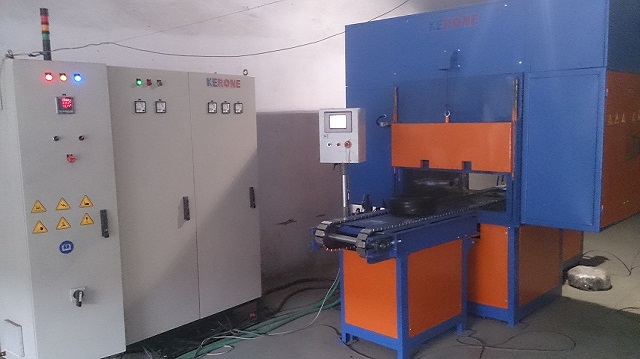
Microwave Heating for Minerals Processing
Click to view high-res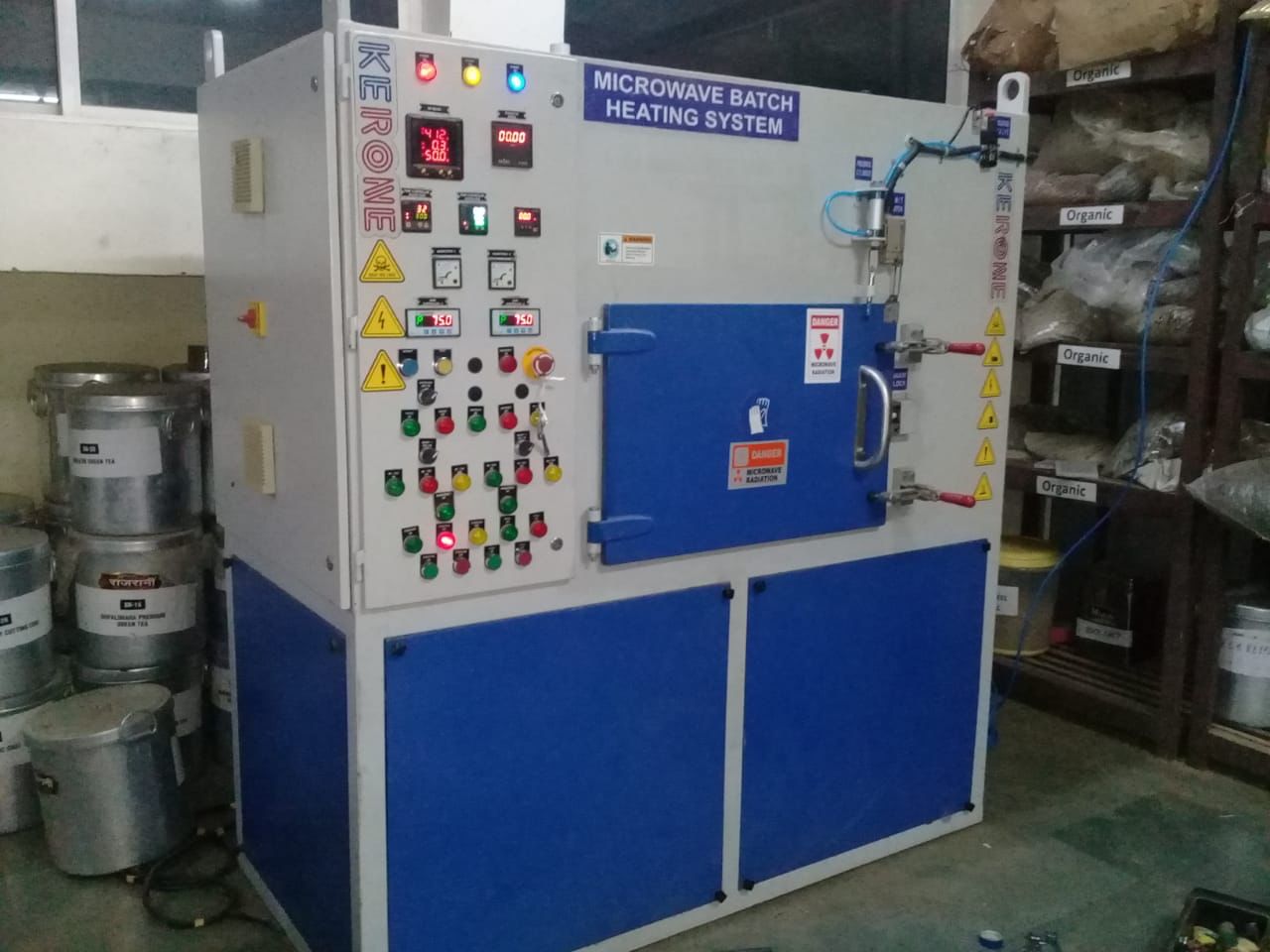
Microwave Heating for Minerals Processing
Click to view high-res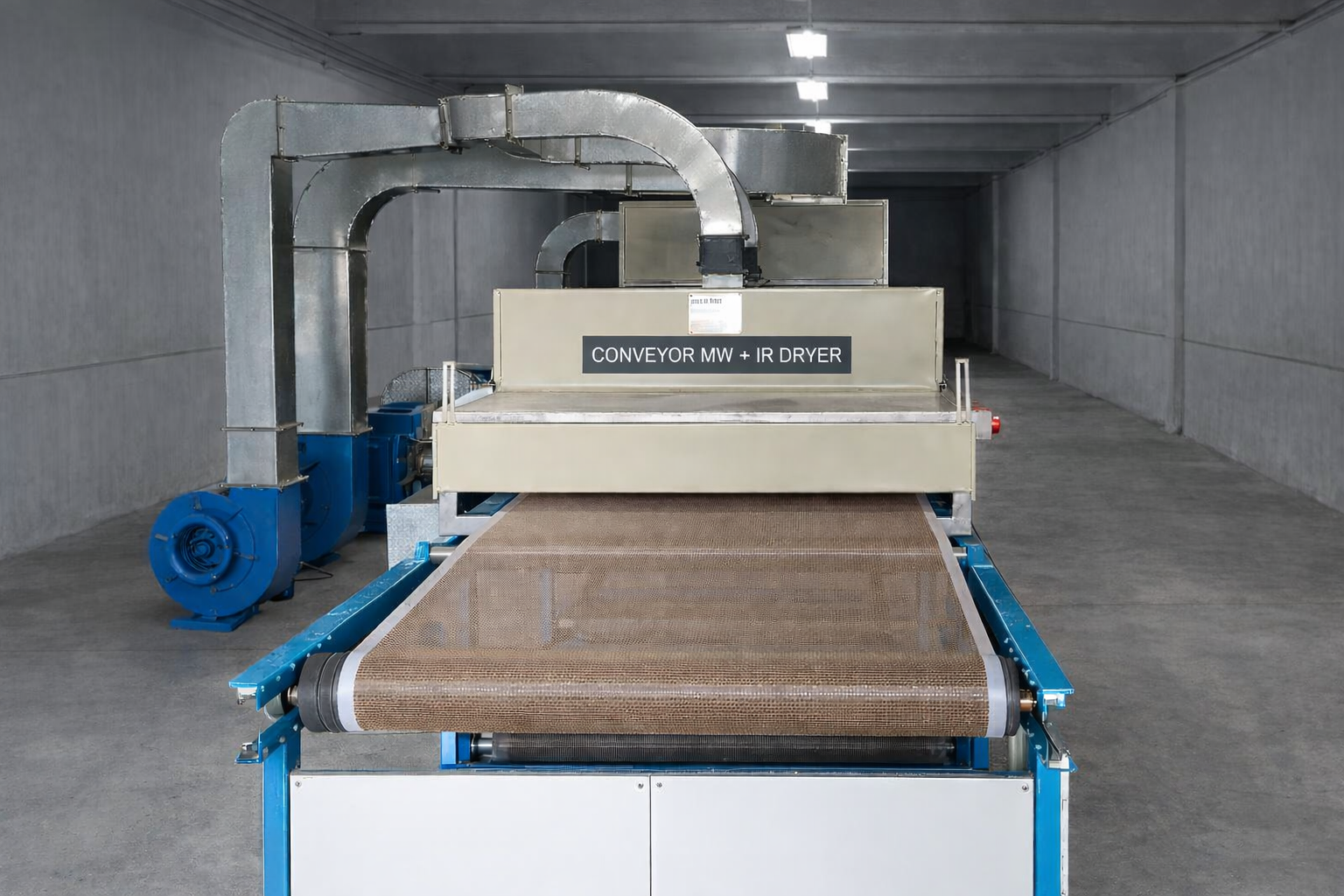
Microwave Heating for Minerals Processing
Click to view high-res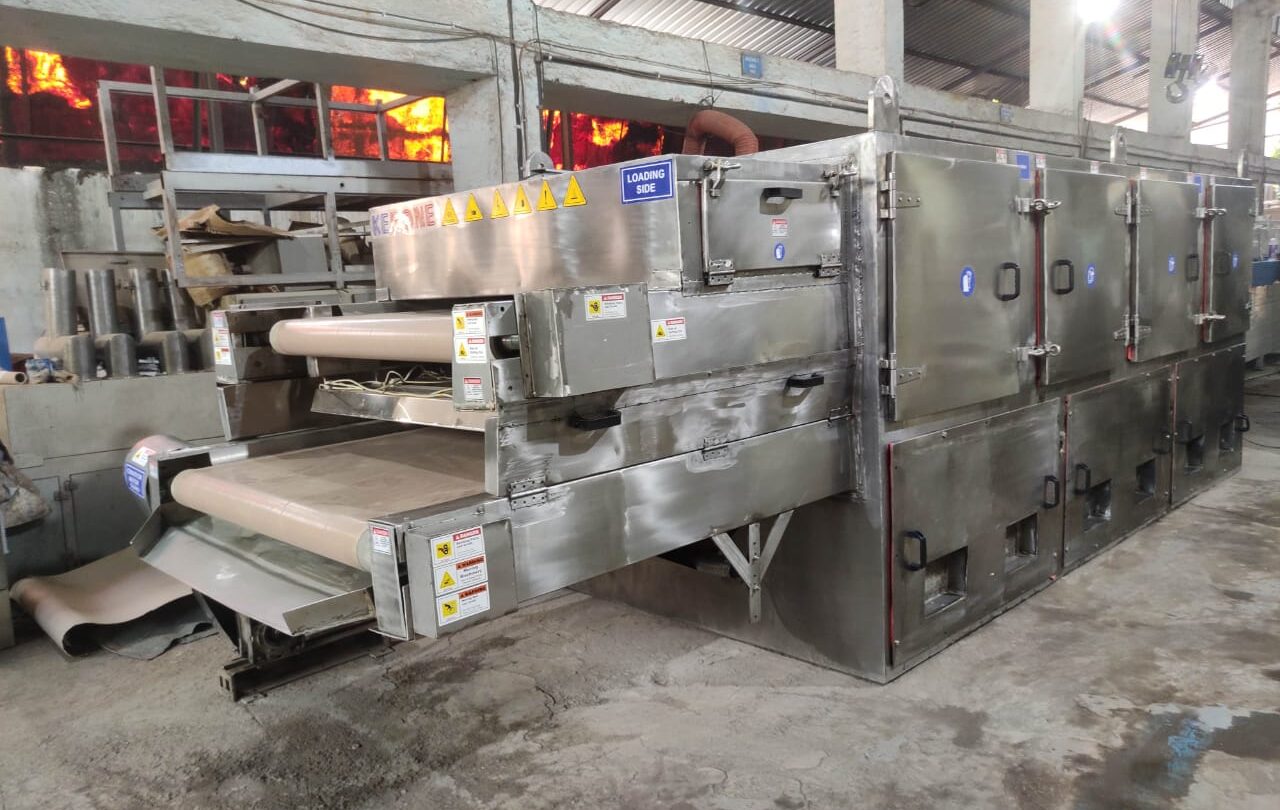
Microwave Heating for Minerals Processing
Click to view high-res
Microwave Heating for Minerals Processing
Click to view high-res
Microwave Heating for Minerals Processing
Click to view high-res50+ Years of Thermal Engineering Leadership.
Since 1976, Kerone Engineering Solutions has delivered over 5,000 custom-engineered thermal and process installations across 50+ countries. In technical collaboration with premier global institutions like CSIR-CEERI and University of Nottingham research partnerships, we design and manufacture high-efficiency machinery that minimizes production downtime and cuts operating expenses.
Unlike standard off-the-shelf equipment suppliers, Kerone operates a complete pilot-scale testing facility at our KRDC Ambernath center. We validate your exact raw material properties — determining moisture sorption isotherms, specific heat capacity, and dielectric behavior — before finalizing equipment sizing, ensuring zero risk during industrial scale-up.
Engineering precision, built into every system.
High Thermal and Processing
High thermal and processing efficiency
Low Maintenance and Easy
Low maintenance and easy operation
Suitable
Suitable for heat-sensitive materials
Fully Adjustable and
Fully adjustable and customizable process parameters
Available in Batch and
Available in batch and continuous configurations
Uniform Processing and
Uniform processing and consistent product quality
Powered by AI, Machine Learning & Smart IoT Integration
Modern industrial processing requires unprecedented thermal precision, energy efficiency, and operational agility. Kerone equips each system with high-speed industrial edge computing controllers, multi-spectral non-contact infrared pyrometry, and proprietary closed-loop machine learning algorithms that continuously analyze process parameters in real time.
The intelligent automation stack monitors dynamic changes in incoming material load, bed thickness, moisture content, and environmental factors. In response, our algorithms dynamically adjust heater power arrays, generator frequency, conveyor drive velocities, and exhaust dampers within milliseconds — entirely eliminating product burn, under-processing, or thermal hotspotting.
Seamlessly integrated with factory-wide SCADA and enterprise ERP architectures via native MQTT, OPC-UA, and Modbus TCP protocols, our systems deliver complete digital recipe control, remote diagnostics, predictive maintenance alerting, and tamper-evident batch logs compliant with global FDA 21 CFR Part 11 and cGMP standards.
Adaptive Heat Modulation
Neural algorithms detect material thermal variations in real time (<50ms response) and tune generator frequency and power arrays automatically.
IoT Cloud Telemetry
Continuous bidirectional telemetry stream via MQTT/OPC-UA protocols directly to centralized plant SCADA, MES, or mobile engineer dashboards.
Predictive Maintenance
Monitors magnetron cathode current, vibration frequency signatures, and differential filter pressure to schedule AMC maintenance before failures occur.
Quality & Batch Traceability
Automated digital recipe execution, multi-stage temperature ramp/soak curves, and cryptographically signed electronic batch logs compliant with 21 CFR Part 11.
Engineered for High-Value Industrial Sectors
Tailored thermal and process configurations across continuous manufacturing lines.
Food industry processing systems
Food industry processing systems
Chemical and polymer processing
Chemical and polymer processing
Pharmaceutical ingredients and inte...
Pharmaceutical ingredients and intermediates
Ready‑to‑eat (RTE) food production
Ready‑to‑eat (RTE) food production
Specialized heating, drying, or mat...
Specialized heating, drying, or material transformation processes
Industrial material modification an...
Industrial material modification and thermal treatment
Configured to Your Process Window
Technical parameter envelopes across industrial manufacturing and engineering architectures.
Frequently Asked Questions
Engineering answers regarding equipment sizing, integration, and process performance.
Industry research, including foundational work by Walkiewicz and colleagues, has identified that heat generation during conventional mineral processing accounts for a substantial share, often cited around 50 to 70 percent, of total energy consumption in some operations, which represents the scale of energy currently used inefficiently that microwave pretreatment targets. Actual achieved savings from implementing microwave pretreatment depend heavily on the specific ore's response characteristics and how the pretreatment integrates with existing comminution circuit design, so published energy savings figures from research studies shouldn't be assumed to transfer directly to a different ore body without site-specific testing. Operators should treat microwave pretreatment as a potential energy reduction strategy requiring validation against their specific ore characteristics rather than a guaranteed percentage improvement applicable universally.
High efficiency, process reliability and complete customization.
Reducing the energy intensity of comminution directly lowers the carbon footprint associated with electricity or fuel consumption for grinding and crushing operations, which represents one of the largest environmental impact categories in mineral processing. Microwave pretreatment that improves liberation of valuable minerals from gangue can also reduce the volume of waste rock requiring disposal for a given amount of recovered mineral, since better liberation efficiency means less material needs to be processed to achieve target recovery rates. Additionally, because microwave heating doesn't involve combustion or chemical reagents in the pretreatment step itself, it avoids adding direct emissions or chemical residue concerns at that specific stage of the process, though downstream extraction and beneficiation steps retain their own separate environmental considerations.
Mineral processing applications generally involve handling abrasive, dense materials in bulk volumes, which requires more robust conveying and material handling systems than food or chemical powder applications, along with greater attention to dust containment and equipment wear resistance given the abrasive nature of crushed rock and ore. Power density requirements also tend to differ, since the goal in mineral processing is often inducing thermal stress fracturing rather than achieving a uniform target temperature throughout the material, which can permit different power and exposure time profiles than food pasteurization or chemical drying applications where uniform temperature achievement is the primary goal. Equipment suppliers typically configure conveying, dust management, and power delivery specifically around the ore characteristics and desired processing outcome rather than applying a generic industrial microwave design across mineral, food, and chemical applications interchangeably.
Kerone ensures high product quality through strict engineering standards, advanced testing procedures, and precision-controlled manufacturing systems.
Microwave pretreatment units are typically positioned between primary crushing and secondary grinding stages, treating ore after initial size reduction has created particle sizes suited to effective microwave exposure but before the energy-intensive fine grinding stage where the energy savings benefit is realized. This positioning allows the microwave stage to be added to an existing circuit as a discrete unit operation without necessarily requiring redesign of the upstream crushing or downstream grinding equipment, provided material handling interfaces and throughput rates are compatible. Integration planning should confirm that the existing circuit's throughput capacity isn't bottlenecked by the microwave stage's processing rate, since a mismatch here would create a new constraint rather than simply adding an energy-saving step.
Microwave-based mineral processing operates on electrical energy converted directly to electromagnetic radiation, producing no combustion emissions and no flue gas requiring scrubbing or treatment, unlike conventional thermal pretreatment methods that rely on burning fossil fuels to achieve target temperatures. Because microwave heating can reduce the energy intensity of downstream grinding, the cumulative energy footprint of the full processing chain, from ore to separated mineral, can be lower than conventional approaches relying solely on mechanical comminution. For mining operations under increasing pressure to report and reduce their carbon footprint, microwave pretreatment offers a pathway to lower both direct emissions from the heating process itself and indirect emissions tied to the substantial electricity demand of grinding circuits.
Microwave heating is suitable for processing gold, copper, iron ore, nickel, zinc, and other mineral concentrates that respond to dielectric heating.
Capacity sizing depends on the ore throughput rate the pretreatment stage needs to support relative to the downstream grinding circuit's design capacity, since the microwave unit must keep pace with the mill feed rate to avoid becoming a bottleneck. Adjustable conveyor speed and heating power allow the system to be tuned for varying ore hardness and moisture content, which fluctuate as mining operations move through different zones of an ore body. Mining operations typically conduct continuous pilot-scale testing across representative ore samples from different parts of the deposit before finalizing full-scale equipment sizing, since a system calibrated only for average ore characteristics may struggle to maintain throughput when processing harder or more variable ore sections.
Since grinding represents such a substantial share of total processing energy in mineral extraction, even modest reductions in required grinding energy translate into meaningful operational cost savings at the scale most mining operations run, given their continuous high-tonnage throughput. Savings show up as reduced electricity consumption per tonne of ore processed through the grinding circuit, potentially extended mill liner and grinding media life due to reduced mechanical stress on pre-weakened ore, and in some cases the ability to achieve target particle size distribution with fewer grinding stages. The exact savings percentage depends heavily on baseline ore hardness and the specific microwave pretreatment parameters applied, which is why most facilities run a detailed pilot trial to quantify expected savings before committing to full-scale implementation.
Mining environments expose processing equipment to abrasive dust, variable ambient temperatures, and continuous high-tonnage material flow, all of which demand robust, compact construction for any equipment installed in this setting. Microwave mineral processing systems are generally built with adjustable conveyor speed and heating controls to handle this variability, along with construction designed for durability under sustained industrial operation. Because there are no burners or combustion-related wear components, maintenance demands tend to be lower than thermal pretreatment alternatives, though the dusty mining environment requires more frequent housekeeping and inspection of seals and access points to prevent material ingress into sensitive electronic and waveguide components than would be typical in a cleaner manufacturing setting.
Microwave pretreatment targets energy reduction specifically at the comminution stage through pre-weakening ore via differential thermal stress, whereas blasting optimization focuses on fragmentation before ore even reaches the plant, and high-pressure grinding rolls represent a mechanical alternative to conventional ball or rod milling. These approaches are not mutually exclusive and are increasingly evaluated in combination, since microwave pretreatment can complement rather than replace other comminution efficiency strategies. The relative cost-effectiveness of microwave pretreatment depends on the specific ore's response to differential heating, existing grinding circuit efficiency, and electricity cost at the operating site, making a site-specific techno-economic study a more reliable basis for investment decisions than general industry comparisons.
A frequent misconception is that laboratory-scale microwave heating results, often achieved with small, well-characterized ore samples under highly controlled conditions, will translate directly to full-scale industrial throughput without significant process engineering. In practice, scaling microwave energy delivery to handle continuous, high-tonnage ore flow while maintaining the differential heating effect that drives micro-fracturing requires careful cavity design, power distribution engineering, and conveyor residence time optimization that differs substantially from small batch laboratory conditions. Mining operations should expect a structured pilot-scale validation phase between laboratory proof of concept and full industrial deployment, rather than assuming laboratory energy reduction percentages will be achieved immediately at production scale.
The economic case for microwave pretreatment investment strengthens with higher ore processing volumes, since the capital cost of microwave equipment is spread across more processed tonnage, and with ores showing strong differential heating response, since this directly determines the magnitude of energy savings achieved in downstream grinding. Operations processing lower-value ore at high volume may find the energy savings alone justify investment, while operations with smaller throughput or ore showing marginal microwave response may find the payback period extends beyond an acceptable threshold. A realistic economic evaluation requires combining ore-specific microwave response testing with the operation's actual energy cost structure and throughput volume, rather than relying on generic industry energy-saving percentages that don't account for site-specific variables.
Mineral composition and mineral association patterns often vary across different zones within a single ore body, meaning the dielectric contrast that drives effective microwave pretreatment in one part of the mine may not be consistent in another zone mined later in the operation's life. This variability means a microwave pretreatment system validated against initial ore samples may show declining or inconsistent benefit as mining progresses into different geological zones, unless the operation periodically reassesses ore characteristics and adjusts microwave processing parameters accordingly. Operations planning long-life mines with known geological variability should factor this into their evaluation of microwave pretreatment economics, treating initial test results as representative of early-stage ore rather than assuming identical performance will hold across the full my life.
Let’s Engineer the Right Process.
From application trials to full-scale production systems, our engineering team works with you to develop the right thermal processing solution for your material, throughput, and production requirements.